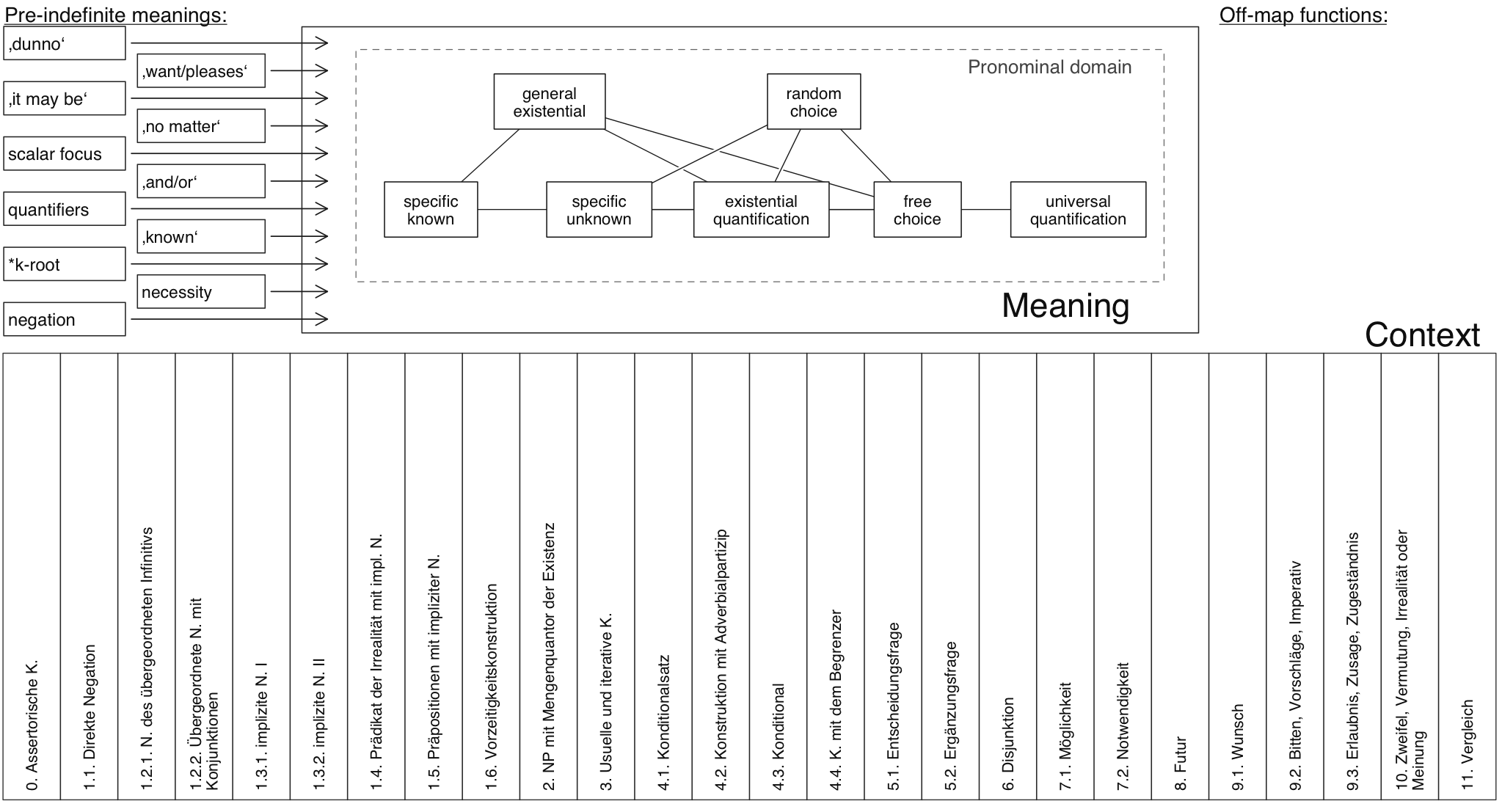
Das integrierte semantisch-distributionelle Kartenmodell besteht aus einem semantischen und einem distributionellen Bereich. Im oberen mittleren Bereich befindet sich die eigentliche semantische Karte der Indefinitpronomen. Links davon werden die präindefiniten Bedeutungen bzw. Grammatikalisierungsquellen der Modifikatoren angegeben; rechts befinden sich die off-map-Funktionen. Der untere Bereich bildet die distributionellen Verwendungskontexte ab.
Die Bezeichnung analytische Primitiva umfasst alle Einheiten, die im Modell als elementare Analysekategorien behandelt werden. Dazu gehören semantische Funktionen, präindefinite Bedeutungen, off-map-Funktionen und distributionelle Kontexte. Der gemeinsame Terminus setzt nicht voraus, dass alle diese Einheiten denselben ontologischen Status besitzen.
Интегрированная семантико-дистрибутивная модель состоит из семантической и дистрибутивной областей. В верхней центральной части расположена собственно семантическая карта неопределённых местоимений. Слева от неё представлены до-неопределённые значения, то есть источники грамматикализации модификаторов, а справа – функции, находящиеся за пределами основной карты. Нижняя часть модели отображает дистрибутивные контексты употребления.
Термин аналитические примитивы объединяет все единицы, рассматриваемые в модели как элементарные категории анализа: семантические функции, до-неопределённые значения, функции за пределами карты и дистрибутивные контексты. Использование общего термина не предполагает, что все эти единицы обладают одинаковым онтологическим статусом.
The integrated semantic-distributional map model consists of a semantic and a distributional domain. The semantic map of indefinite pronouns is located in the upper central part. Pre-indefinite meanings, that is, the grammaticalization sources of the modifiers, are shown to its left, while off-map functions are shown to its right. The lower part represents the distributional contexts of use.
The term analytical primitives covers all units treated as elementary analytical categories in the model: semantic functions, pre-indefinite meanings, off-map functions, and distributional contexts. The common term does not imply that all these units have the same ontological status.
Die Graphstruktur, also die Verbindungen zwischen den Funktionen, ist semantisch relevant. Die räumliche Anordnung der Knoten dient dagegen lediglich einer übersichtlichen Darstellung.
Семантически значима структура графа, то есть связи между функциями. Пространственное расположение узлов служит только для наглядного представления карты.
The graph structure, that is, the connections between the functions, is semantically relevant. The spatial arrangement of the nodes serves only to make the map easier to read.
Der Kernbereich der Karte umfasst sieben semantische Funktionen.
| Primitivum | Beschreibung |
|---|---|
| specific known | Schwach bestimmte Referenz: Der Referent ist dem Sprecher bekannt, dem Hörer jedoch unbekannt. |
| general existential | Allgemein-existenzielle Verwendung: Es wird über Objekte mit bestimmten Eigenschaften gesprochen, ohne einzelne Individuen auszuwählen. |
| specific unknown | Spezifisch-unbestimmte Referenz: Die Existenz eines Referenten wird vorausgesetzt, dieser bleibt jedoch beiden Kommunikanten unbekannt. |
| existential quantification | Existenzielle Quantifizierung: Mindestens ein Element einer Klasse erfüllt die angegebenen Bedingungen. |
| universal quantification | Universelle Quantifizierung: Die Verwendung bezieht sich auf alle Vertreter einer Menge oder erfasst ein Objekt als kohärentes Ganzes. |
| free choice | Freie Wahl: Die Menge möglicher Alternativen ist nicht beschränkt; die Wahl ist nicht an bestimmte Bedingungen geknüpft. |
| random choice | Zufällige Wahl: Ein Vertreter wird ohne erkennbare Auswahlkriterien gewählt und häufig als wenig geeignet oder ungeeignet bewertet. |
Ядро карты включает семь семантических функций.
| Примитив | Описание |
|---|---|
| specific known | Слабоопределённая референция: референт известен говорящему, но неизвестен слушающему. |
| general existential | Общеэкзистенциальное употребление: речь идёт об объектах с определёнными свойствами без выделения отдельных индивидуальных референтов. |
| specific unknown | Специфическая неопределённая референция: существование референта предполагается, однако он неизвестен обоим коммуникантам. |
| existential quantification | Экзистенциальная квантификация: по меньшей мере один элемент класса удовлетворяет заданным условиям. |
| universal quantification | Универсальная квантификация: употребление относится ко всем представителям множества или охватывает объект как единое целое. |
| free choice | Свободный выбор: множество возможных альтернатив не ограничено, а выбор не связан с определёнными условиями. |
| random choice | Случайный выбор: представитель множества выбирается без очевидных критериев и нередко оценивается как мало подходящий или неподходящий. |
The core domain of the map contains seven semantic functions.
| Primitive | Description |
|---|---|
| specific known | Weakly definite reference: the referent is known to the speaker but unknown to the hearer. |
| general existential | General existential use: objects with particular properties are referred to without selecting individual referents. |
| specific unknown | Specific indefinite reference: the existence of a referent is presupposed, but the referent is unknown to both interlocutors. |
| existential quantification | Existential quantification: at least one member of a class satisfies the relevant conditions. |
| universal quantification | Universal quantification: the expression refers to all members of a set or treats an object as a coherent whole. |
| free choice | Free choice: the set of possible alternatives is unrestricted, and the choice is not tied to particular conditions. |
| random choice | Random choice: a member of a set is selected without an identifiable criterion and is often evaluated as unsuitable or of low quality. |
Die off-map-Funktionen liegen außerhalb der eigentlichen pronominalen Domäne der Indefinitheit. Dazu gehören isolierte Konstruktionen sowie quantitative, evaluative und intensivierend-abschwächende Bedeutungen.
| Primitivum | Beschreibung |
|---|---|
| a lot | große, nicht genauer bestimmte Menge |
| a little | geringe Menge oder niedriger Grad |
| only | Beschränkung auf eine einzige Person, einen Gegenstand oder eine Möglichkeit |
| quality quantification | Abschwächung oder Verstärkung des Grades einer Eigenschaft |
| distancing | Distanzierung des Sprechers von einer Situation oder von bestimmten Umständen |
| (not)mediocrity | unterdurchschnittliche bzw. ausdrücklich nicht mittelmäßige Qualität |
| most | Extremwert auf einer Skala oder freie Annäherung an einen Skalenpol |
| ca. | ungefähre quantitative, zeitliche oder räumliche Bestimmung |
| (un)important | hervorgehobene Bedeutung oder geringe Relevanz |
| isolated construction | isolierte syntaktische Verwendung, in der die Form nicht als Indefinitpronomen fungiert |
| hardly | ein beinahe eingetretenes, letztlich aber nicht realisiertes Ereignis |
| (not)common | ungewöhnliche oder über das gewöhnliche Maß hinausgehende Eigenschaft |
Эти функции находятся за пределами собственно местоименной области неопределённости. К ним относятся изолированные конструкции, а также количественные, оценочные, усилительные и ослабляющие значения.
| Примитив | Описание |
|---|---|
| a lot | большое, точнее не определённое количество |
| a little | малое количество или низкая степень |
| only | ограничение одним лицом, предметом или одной возможностью |
| quality quantification | ослабление или усиление степени признака |
| distancing | дистанцирование говорящего от ситуации или определённых обстоятельств |
| (not)mediocrity | качество ниже среднего либо подчёркнуто немедиокритетное качество |
| most | крайнее значение на шкале или свободное приближение к её полюсу |
| ca. | приблизительное количественное, временное или пространственное определение |
| (un)important | подчёркнутая значимость либо незначительность и малая релевантность |
| isolated construction | изолированное синтаксическое употребление, в котором форма не функционирует как неопределённое местоимение |
| hardly | событие, которое едва не произошло, но в итоге не было реализовано |
| (not)common | необычное или выходящее за пределы обычного свойство |
Off-map functions lie outside the pronominal domain of indefiniteness proper. They include isolated constructions as well as quantitative, evaluative, intensifying, and attenuating meanings.
| Primitive | Description |
|---|---|
| a lot | a large, non-specified quantity |
| a little | a small quantity or a low degree |
| only | restriction to a single person, object, or possibility |
| quality quantification | attenuation or intensification of the degree of a property |
| distancing | the speaker’s distancing from a situation or particular circumstances |
| (not)mediocrity | below-average or explicitly non-mediocre quality |
| most | an extreme value on a scale or free approximation to a scale endpoint |
| ca. | an approximate quantitative, temporal, or spatial specification |
| (un)important | highlighted importance or low relevance |
| isolated construction | an isolated syntactic use in which the form does not function as an indefinite pronoun |
| hardly | an event that almost occurred but was ultimately not realized |
| (not)common | an unusual or more-than-ordinary property |
Die Karten des Typs I und II beruhen auf unterschiedlichen Datengrundlagen und verwenden deshalb teilweise unterschiedliche Kontextinventare. Zwischen den beiden Listen kann über die Registerkarten gewechselt werden.
Карты типов I и II основаны на разных массивах данных, поэтому наборы учитываемых контекстов частично различаются. Между двумя списками можно переключаться при помощи вкладок.
Maps of types I and II are based on different datasets and therefore use partly different context inventories. Use the tabs to switch between the two lists.
Karten des Typs I beruhen auf gezielten korpusbasierten Suchen nach einzelnen Kontexttypen. Interferenzen mit anderen Kontexten werden nach Möglichkeit ausgeschlossen. Die Größe eines semantischen Knotens zeigt, in wie vielen Kontexten die betreffende Funktion zentral ist. Die Balken im distributionellen Bereich geben den SKAI-Wert wieder und zeigen damit die relative Stärke der Verbindung zwischen einer Reihe und einem Kontext.
Карты типа I основаны на целевых корпусных поисках отдельных типов контекстов. Интерференция с другими контекстами по возможности исключается. Размер семантического узла показывает, в скольких контекстах соответствующая функция является центральной. Столбцы в дистрибутивной области передают значение SKAI, то есть относительную силу связи между серией и контекстом.
Type I maps are based on targeted corpus searches for individual context types. Interference from other contexts is excluded whenever possible. The size of a semantic node indicates the number of contexts in which the function is central. The bars in the distributional domain represent SKAI values and therefore the relative strength of association between a series and a context.
Karten des Typs II beruhen auf Zufallsstichproben von jeweils 100 Korpusbelegen. Die Größe der semantischen Knoten entspricht der Zahl der Belege, in denen die jeweilige Funktion identifiziert wurde. Die Balken bei den Kontexten zeigen deren absolute Häufigkeit innerhalb der Stichprobe. Da einem Beleg mehrere Kontexte zugeordnet werden können, kann die Gesamtzahl der Kontextzuweisungen über 100 liegen.
Карты типа II основаны на случайных выборках по 100 корпусных употреблений. Размер семантических узлов соответствует числу примеров, в которых была выявлена соответствующая функция. Столбцы у контекстов показывают их абсолютную частоту в выборке. Поскольку одному примеру может быть приписано несколько контекстов, общее число контекстных отнесений может превышать 100.
Type II maps are based on random samples of 100 corpus attestations. The size of a semantic node corresponds to the number of attestations in which the function was identified. The bars next to the contexts show their absolute frequencies within the sample. Since one attestation may be assigned to several contexts, the total number of context assignments may exceed 100.
Im linken Bereich der Karten wird die Grammatikalisierungsquelle des Modifikators angegeben. Für die kartierten Reihen werden folgende Quelltypen unterschieden:
В левой части карт указывается источник грамматикализации модификатора. Для картированных серий различаются следующие типы источников:
The grammaticalization source of the modifier is shown in the left-hand area of the maps. The following source types are distinguished for the mapped series:
roman [at] fisun.org